Communication Skills MCQs
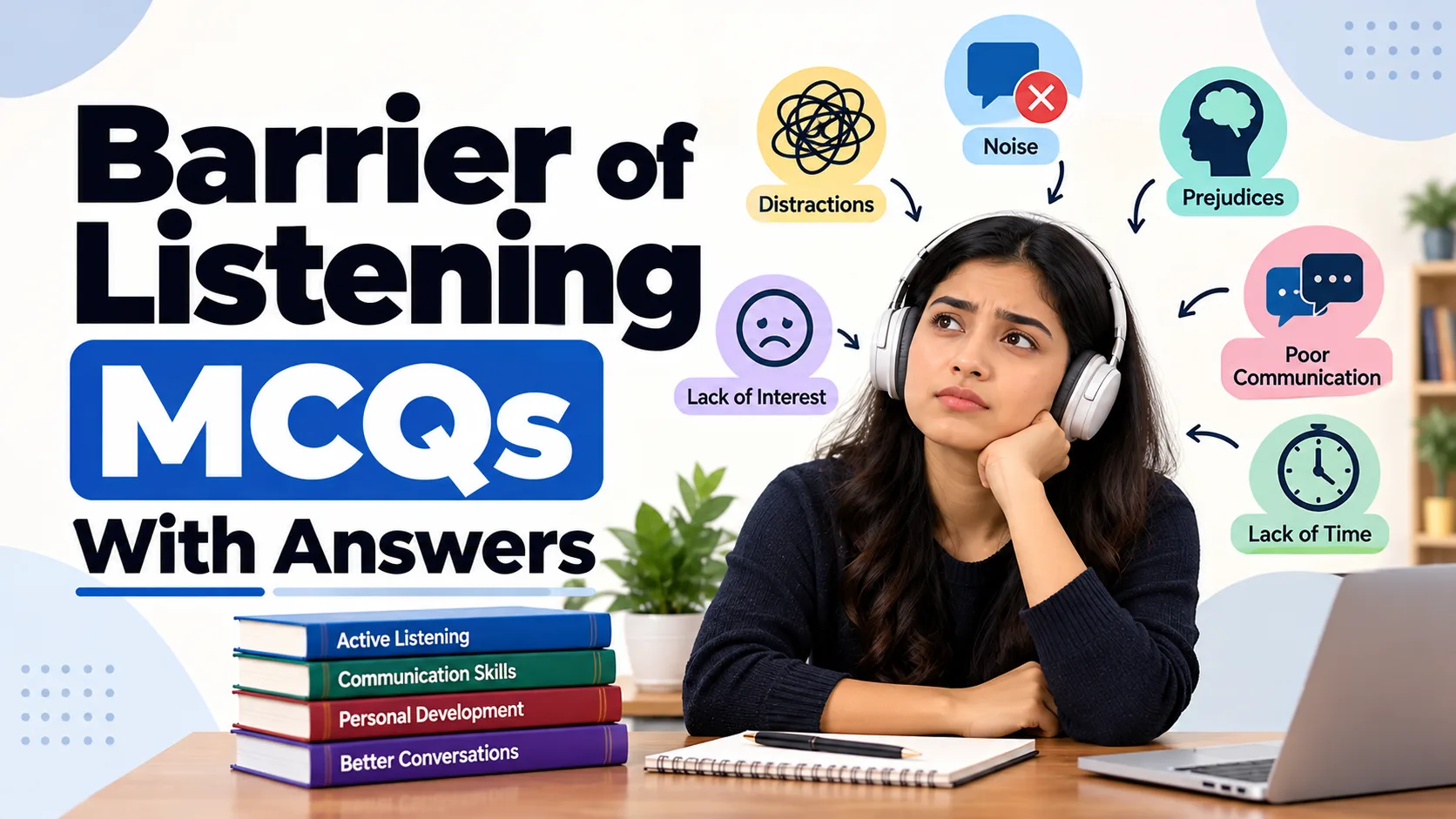
Barrier of Listening MCQs with Answers
Practice Barriers of Listening MCQs with Answers to test your knowledge of common listening barriers, including distractions, noise, lack of attention, language differences, and emotional interference. These listening barriers multiple-choice questions with correct answers and explanations help students prepare for exams and improve their listening and communication skills.
56 questionsOct 14, 2026
1. Which is the main barrier of listening?
(a)Comprehensive
(b)Physical
Correct(c)Narrative
(d)None of these
Explanation: Physical barriers, such as noise, distance, and environmental distractions, can prevent listeners from hearing and understanding a speaker clearly.
2. Armchair psychology comes from logic and what?
(a)Introspection
Correct(b)Self-desire
(c)Interrelation
(d)All of them
Explanation: The supplied answer identifies introspection, or examining one's own thoughts and experiences, as the other source.
3. Assumptions damage our _____ to relate to others.
(a)Thinking
(b)Capacity
Correct(c)Memory
(d)Feelings
Explanation: The original list did not provide an answer. “Capacity” is inferred from the sentence: assumptions can damage our capacity to relate to others.
4. Armchair psychology is contrasted with which approach?
(a)Physical psychology
(b)Thinking process
(c)Empirical psychology
Correct(d)None of these
Explanation: Empirical psychology relies on systematic observation and evidence, unlike armchair approaches based mainly on reflection or speculation.
5. Can assumptions be good?
(a)Yes
(b)No
(c)Generally not good
Correct(d)Maybe
Explanation: The supplied answer is “Generally not good.” In practice, assumptions can be useful as tentative starting points if they are checked against evidence.
6. How can you check your assumptions while reading a sentence?
(a)Write in sequence
(b)Write in verbal mode
(c)Read the sentence again
Correct(d)Check your mistake
Explanation: Rereading can help you notice whether you have added meaning that the sentence does not actually state.
7. How would you examine an assumption?
(a)Cross-validate it
Correct(b)Read it again
(c)Check that the question is perfect
(d)Both A and C
Explanation: Cross-validation means checking an assumption against other evidence or perspectives rather than accepting it immediately.
8. What is often described as the most fundamental and difficult listening skill?
(a)Hearing
(b)Being quiet
Correct(c)Speaking
(d)Writing
Explanation: Being quiet gives the other person space to speak and helps the listener focus instead of interrupting.
9. How can assumptions negatively affect us?
(a)By thinking in double meanings
(b)By relating things to each other
(c)Because of not understanding
(d)By making unconscious judgments
CorrectExplanation: Assumptions can lead to unconscious judgments when we accept an interpretation without checking the evidence.
10. How do you practice new things?
(a)By learning
(b)By testing yourself
Correct(c)Both A and B
(d)None of these
Explanation: Testing yourself provides practice and feedback, helping you identify what you understand and what needs more work.
11. Why is it important to state your assumptions?
(a)To get an opportunity to challenge your employees
Correct(b)To cross-check
(c)To give a valid reason
(d)To help themselves
Explanation: The supplied answer is option A. Stating assumptions makes them visible so they can be questioned and examined.
12. Which is the main barrier of listening?
(a)Comprehensive
(b)Physical
Correct(c)Narrative
(d)None of these
Explanation: Physical barriers, such as background noise or distance, can prevent a listener from hearing a message clearly.
13. Which one is the main component of listening?
(a)Writing
(b)Speaking
(c)Hearing
Correct(d)Sense of humor
Explanation: Hearing is the sensory process that allows sound to reach us. Listening also involves interpreting and understanding what is heard.
14. Which of the following is a negative type of body language?
(a)Avoidance of eye contact
Correct(b)Gestures
(c)Postures
(d)Use of hands
Explanation: Avoiding eye contact can sometimes be interpreted as discomfort, disengagement, or lack of confidence, depending on the context and culture.
15. Nodding and saying “mm” or “hmmm” usually signals what?
(a)Keep talking
Correct(b)Be quiet
(c)Do not disturb
(d)End the conversation
Explanation: These small verbal and non-verbal cues can show attention and encourage the speaker to continue.
16. Which of the following is categorized as non-verbal communication?
(a)Cognition
(b)Paralanguage
Correct(c)Thinking
(d)Smelling
Explanation: Paralanguage includes vocal features such as tone, pitch, and pace that accompany spoken words.
17. How would you plan how to deal with assumptions?
(a)By thinking about them
(b)With ideas
(c)Determine their criticality
Correct(d)Having reasons
Explanation: Determining criticality helps decide which assumptions matter most and should be checked first.
18. Practice is the act of _____ a behavior.
(a)Doing something
(b)Working
(c)Rehearsing
Correct(d)Improving
Explanation: Practice involves rehearsing or repeatedly performing a behavior or skill to develop proficiency.
19. A fine line exists between reflecting understanding and quoting someone how?
(a)Ranking
(b)Verbatim
Correct(c)Communication
(d)None of them
Explanation: Verbatim means repeating someone's words exactly; reflecting understanding restates the meaning in your own words.
20. Which one is called a secret communication tool?
(a)Body language
(b)Skills
(c)Sense of humor
(d)Silence
CorrectExplanation: Silence can communicate attention, hesitation, disagreement, reflection, or emotion without words.
21. When speaking and listening about unfamiliar content, which requirement becomes greater?
(a)Physical
(b)Cognitive
Correct(c)Writing
(d)Speaking
Explanation: Unfamiliar content requires more cognitive effort to process, interpret, and understand.
22. What kind of process is listening?
(a)Active
Correct(b)Passive
(c)Non-active
(d)Both passive and non-active
Explanation: Listening is generally considered an active process because it requires attention and interpretation.
23. Where do most assumptions come from?
(a)Books
(b)Past experiences
Correct(c)Hypotheses
(d)Observations
Explanation: Past experiences can shape expectations, although those expectations may not always fit a new situation.
24. Where does unsolicited advice often come from?
(a)Measurements
(b)Hypotheses
(c)Observations that people find helpful for themselves
Correct(d)Both A and C
Explanation: People may offer advice based on what they have observed or found useful in their own lives, even when it may not suit someone else.
25. Why do people make assumptions?
(a)To save the brain's energy
Correct(b)To relate things
(c)To clear queries
(d)None of these
Explanation: Assumptions can act as mental shortcuts, reducing the effort needed to interpret situations, but they can also lead to errors.
26. Why can unsolicited advice be unhelpful?
(a)Because it causes disturbance
(b)It has the potential to create stress
Correct(c)It does not work
(d)Both A and C
Explanation: Advice that was not requested can feel pressuring or dismissive and may add stress rather than help.
27. What is the main purpose of note-taking while listening?
(a)Record every word without thinking
(b)Capture key ideas for later review
Correct(c)Avoid listening to the speaker
(d)Fill the page with unrelated information
Explanation: Effective notes capture main ideas, evidence, and useful details that can be reviewed later.
28. What is appreciative listening?
(a)Listening for enjoyment or pleasure
Correct(b)Listening only to find errors
(c)Listening to interrupt
(d)Listening only for instructions
Explanation: Appreciative listening is used to enjoy experiences such as music, stories, or entertaining speech.
29. What does critical listening involve?
(a)Accepting every claim immediately
(b)Evaluating claims and supporting evidence
Correct(c)Listening only for emotional words
(d)Ignoring the speaker's reasons
Explanation: Critical listening involves examining the logic, evidence, and credibility behind a message.
30. What is paraphrasing in communication?
(a)Repeating every word exactly
(b)Restating a message in your own words
Correct(c)Changing the subject
(d)Giving unrelated advice
Explanation: Paraphrasing restates the meaning of a message in different words to confirm understanding.
31. Which response best demonstrates active listening?
(a)Planning your reply while the person speaks
(b)Summarizing the speaker's main point
Correct(c)Interrupting to give advice
(d)Changing the subject
Explanation: Summarizing the main point checks your understanding and gives the speaker a chance to correct it.
32. What is the best way to show a speaker that you are listening attentively?
(a)Interrupt frequently
(b)Maintain appropriate eye contact and focus
Correct(c)Look at your phone
(d)Change the topic
Explanation: Appropriate eye contact and focused attention can signal engagement, while cultural norms and individual comfort should be respected.
33. What should you do when you do not understand a speaker's point?
(a)Pretend to understand
(b)Ignore the point
(c)Ask a respectful clarifying question
Correct(d)Immediately disagree
Explanation: Clarifying questions help prevent misunderstandings and show that you want to understand the speaker accurately.
34. Which skill is most useful for identifying the main idea of a long message?
(a)Focusing on every minor detail equally
(b)Listening for key points and repeated themes
Correct(c)Ignoring transitions
(d)Memorizing unrelated words
Explanation: Key points, signposting, and repeated themes often reveal the central message.
35. Which behavior is most likely to interrupt effective listening?
(a)Taking relevant notes
(b)Removing distractions
(c)Thinking about an unrelated task
Correct(d)Asking for clarification
Explanation: Attention divided by unrelated thoughts makes it harder to process and remember a message.
36. What is the benefit of summarizing a discussion at the end?
(a)It checks shared understanding and next steps
Correct(b)It introduces unrelated topics
(c)It avoids decisions
(d)It proves one person is always right
Explanation: A brief summary can confirm decisions, responsibilities, and any remaining questions.
37. What should a listener do before evaluating a speaker's argument?
(a)Understand the argument fully
Correct(b)Assume the speaker is wrong
(c)Ignore the supporting evidence
(d)Judge the speaker's appearance
Explanation: Understanding the claim and its supporting reasons first makes evaluation fairer and more accurate.
38. What is the purpose of feedback in a conversation?
(a)To confirm how a message was understood
Correct(b)To distract the speaker
(c)To avoid responding
(d)To replace the original message
Explanation: Feedback helps speakers and listeners check whether the intended meaning has been understood.
39. What is defensive listening?
(a)Listening for criticism and reacting as if attacked
Correct(b)Listening carefully to instructions
(c)Taking notes during a class
(d)Asking neutral questions
Explanation: Defensive listening occurs when a person interprets comments as personal attacks, even when that may not be intended.
40. What is selective listening?
(a)Giving equal attention to every detail
(b)Focusing only on parts that interest or support one's views
Correct(c)Listening without hearing sound
(d)Repeating the message word for word
Explanation: Selective listening occurs when a person attends to only certain parts of a message, potentially missing important information.
41. Why is it useful to ask open-ended questions while listening?
(a)They encourage fuller responses
Correct(b)They end conversations quickly
(c)They prevent the speaker from explaining
(d)They always require yes-or-no answers
Explanation: Open-ended questions invite the speaker to explain experiences, reasons, and feelings in more detail.
42. Which is the best example of a clarifying question?
(a)Why are you always wrong?
(b)Could you explain what you mean by that deadline?
Correct(c)That makes no sense
(d)Can we talk about something else?
Explanation: A neutral question about a specific point helps resolve uncertainty without blaming the speaker.
43. Which is an example of a physical listening barrier?
(a)Background construction noise
Correct(b)A clear summary
(c)A relevant question
(d)Careful attention
Explanation: Environmental noise can make speech difficult to hear and understand.
44. Which factor can make a listener more likely to misinterpret a message?
(a)Checking context
(b)Unexamined personal bias
Correct(c)Asking follow-up questions
(d)Summarizing the message
Explanation: Personal biases can shape how information is interpreted before the full message is considered.
45. What does empathetic listening focus on?
(a)Finding faults in every statement
(b)Understanding the speaker's feelings and perspective
Correct(c)Winning an argument
(d)Preparing an immediate solution
Explanation: Empathetic listening aims to understand the other person's perspective and emotional experience.
46. What is the purpose of allowing pauses in a conversation?
(a)Give people time to think and respond
Correct(b)Show that listening has ended in every case
(c)Prevent the other person from speaking
(d)Make the message less clear
Explanation: Pauses can provide time for reflection and give the speaker or listener space to formulate a response.
47. Which habit supports better listening in a conversation?
(a)Preparing a rebuttal before the speaker finishes
(b)Keeping an open mind
Correct(c)Making assumptions about every pause
(d)Multitasking continuously
Explanation: An open mind helps listeners consider information fairly before forming a conclusion.
48. Which practice helps reduce assumptions about another person's intentions?
(a)Treating guesses as facts
(b)Asking the person directly and respectfully
Correct(c)Relying only on rumors
(d)Avoiding all communication
Explanation: Respectful questions help distinguish what someone actually means from what a listener merely suspects.
49. Why should a listener avoid interrupting unnecessarily?
(a)It gives the speaker time to complete their thought
Correct(b)It makes every message shorter
(c)It guarantees agreement
(d)It removes the need for questions
Explanation: Allowing the speaker to finish supports clarity and communicates respect.
50. Why is it important to consider context when interpreting words?
(a)Words always mean exactly the same thing
(b)Context can change the intended meaning
Correct(c)Context is unrelated to communication
(d)It prevents all disagreement
Explanation: The situation, relationship, and surrounding words can affect what a speaker intends to communicate.
51. What should you do if you notice you have misunderstood someone?
(a)Blame the speaker
(b)Acknowledge it and ask them to clarify
Correct(c)Continue as if nothing happened
(d)Repeat the incorrect interpretation more firmly
Explanation: Acknowledging uncertainty and checking the meaning helps correct misunderstandings early.
52. Which action can help improve concentration during a lecture?
(a)Checking messages repeatedly
(b)Sitting where you can hear clearly and taking useful notes
Correct(c)Holding unrelated conversations
(d)Ignoring the lecture structure
Explanation: Reducing distractions, choosing a suitable seat, and taking focused notes can support attention.
53. Which listening approach is most appropriate during a disagreement?
(a)Listen to understand before responding
Correct(b)Raise your voice over the other person
(c)Assume bad intentions
(d)Stop paying attention
Explanation: Listening before responding helps identify the other person's concerns and can reduce unnecessary conflict.
54. Which statement best describes listening for detail?
(a)Identifying specific facts such as names, dates, or figures
Correct(b)Ignoring all examples
(c)Only noticing the speaker's mood
(d)Guessing the message without listening
Explanation: Listening for detail means paying attention to specific information within a message.
55. What is the best response when a speaker expresses strong emotions?
(a)Dismiss the emotion
(b)Listen calmly and acknowledge the concern
Correct(c)Immediately change the topic
(d)Tell the speaker not to feel that way
Explanation: Calm attention and acknowledgment can help the speaker feel heard without requiring you to agree with every claim.
56. Which is a useful way to respond to constructive criticism?
(a)Reject it without listening
(b)Listen for specific points and consider the evidence
Correct(c)Attack the person giving it
(d)Assume it is always an insult
Explanation: Considering specific feedback and evidence makes it easier to identify useful improvements.